Chapter 05 / 06 · 1940s
Man of Two Wars
Battles Within and Without
Nazi Occupation and Greek Civil War
The person behind the portrait
This self-portrait considers what one generation passes to the next. The artist’s parents lived through the Nazi occupation and the Greek Civil War; their experiences continued through family stories, anxieties, and silences.
Petrides uses his own face to explore the effects of that inheritance. The broken and worked surface gives physical form to conflict, endurance, and the wish to heal.
Artwork details and materials
- Reference
- HH·05
- Model
- George Petrides
- In the family
- Self-portrait
- Themes
- Inherited trauma and inner conflict
- Sculptural precedent
- Pierre de Wissant (1886), from Rodin’s Burghers of Calais
- Completed
- 2024 · Version II
- Medium
- Mixed media: a 3D-printed recycled PETG body, epoxy clay, metal powders applied with resin and catalyst, pigments, acids, and a protective topcoat.
- Dimensions
- 91 × 55 cm, height × diameter
The date identifies the version shown. The exhibition began touring in 2022.
Views and surface details
Select an image to see it in full.
The films
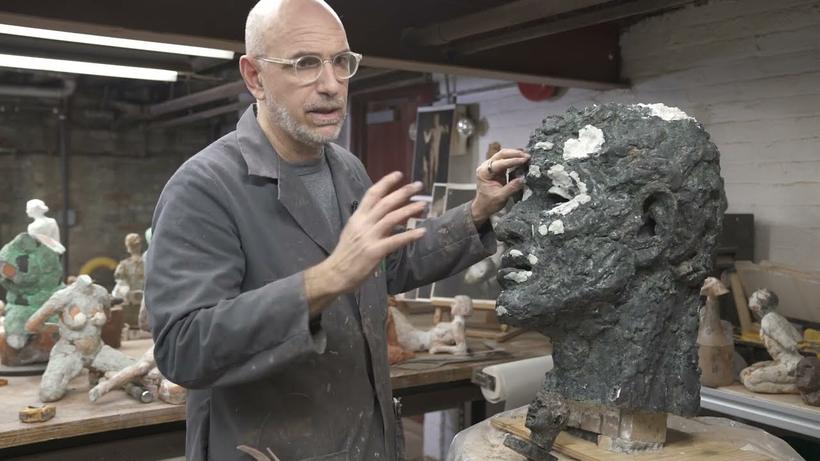
Films retain their original audio. Where YouTube supplies captions, use the CC control. The text on this page introduces the sculpture and its historical setting.
History and inspiration
German forces invaded Greece in April 1941. Occupation brought famine, reprisals, resistance, and the near destruction of the country’s Jewish communities in the Holocaust. The ensuing Civil War, ending in 1949, deepened the devastation and divisions.
The sculpture asks how such events persist in people who did not experience them directly. Rodin’s Pierre de Wissant, one of the Burghers of Calais, offered a model of the human figure under emotional strain.
Read the full catalog chapter (English)The artist’s words (English)
"The first three heads—Refugee, Thalia, and Archon— convey the emotional environment in which I was raised. I hope that the sculptures are successful enough that you can pick up the emotions rather than my describing them to you in writing. I then turned my gaze on myself and began to recognize my own burdens. The full name of the sculpture is Man of Two Wars: The Battle Within and Without, referring to my experience that I had to fight on both the inside and outside fronts, often at the same time. One front was the external: to build a life across two countries, two careers, and even two marriages. The other was internal: my own psychological issues, which I worked hard to resolve and perhaps, to a large extent, have managed to. My parents and grandparents did not have the option of processing their trauma; they had to ignore it and focus on surviving. Born further away from the physical trauma, and with contemporary resources available to me, I had to undertake the work of understanding and healing whatever I could for my own well-being—and for the quality of life in my family. As to the sculpture, it is inspired by one of the heads of Rodin’s Burghers of Calais. You may know the story of the six burghers who turned themselves over to be hanged during the siege of Calais in 1347. With dignity they marched to their death (and by luck were spared by the pleading of the king’s pregnant wife). In my sculpture I convey a similar agony—perhaps at a low point, perhaps not far from when the healing coalesces and I come out on the other, better side. No doubt my making this sculpture was in itself part of my healing process."
Contact the studio
Arrange a visit in Berlin, discuss an institutional project, or request information about a work.