Chapter 03 / 06 · 1820s
Heroines
Female Leadership
Greek War of Independence
The person behind the portrait
Eleftheria Gkoufa posed for Heroines in 2021. The sculpture connects her strength and independence with women whose leadership shaped the Greek struggle for independence.
The title is plural: this is a tribute to many women, rather than a likeness of one historical heroine. The portrait brings courage and determination into the present.
Artwork details and materials
- Reference
- HH·03
- Model
- Eleftheria Gkoufa
- In the family
- Wife, who posed in 2021
- Themes
- Courage and female leadership
- Sculptural precedent
- Saïd Abdullah (modeled 1848), by Charles Cordier; casts at the Art Institute of Chicago and the Walters Art Museum
- Completed
- 2024 · Version II
- Medium
- Mixed media: a 3D-printed recycled PETG body, epoxy clay, metal powders applied with resin and catalyst, pigments, acids, and a protective topcoat.
- Dimensions
- 88 × 55 cm, height × diameter
The date identifies the version shown. The exhibition began touring in 2022.
Views and surface details
Select an image to see it in full.
The films
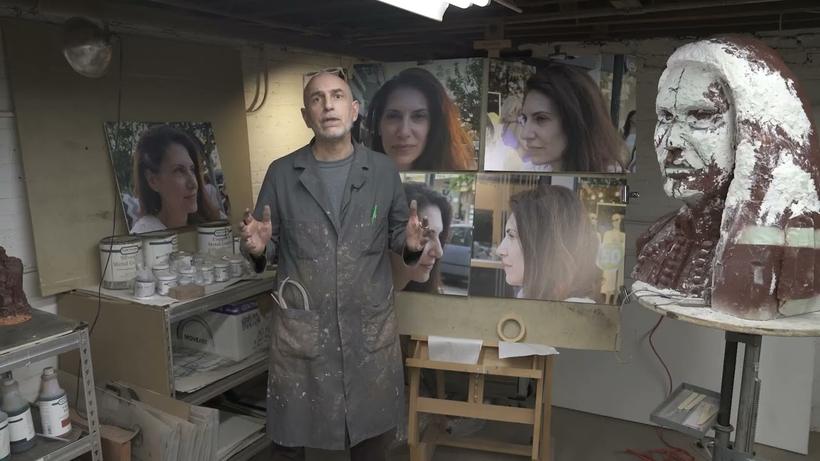
Films retain their original audio. Where YouTube supplies captions, use the CC control. The text on this page introduces the sculpture and its historical setting.
History and inspiration
The Greek War of Independence began in 1821 after centuries of Ottoman rule. Its history includes military struggle, civil conflict, international intervention, and the work of women such as Laskarina Bouboulina and Manto Mavrogenous.
The sculptural starting point was Charles Cordier’s Saïd Abdullah, a portrait whose presence and expressive detail offered a way to explore strength in a contemporary face. Heroines carries the question of female leadership beyond the nineteenth century.
Read the full catalog chapter (English)The artist’s words (English)
"Heroines is modeled on my wife, Eleftheria, who shares similar cultural history to my own, as one side of her family is also from Smyrna. Although her parents are younger than mine and thus lived through less of the terrible decade of the 1940s in Greece, many of the same influences persisted. Her processing and response differed from mine: she developed a forceful way of moving through the world, often closely guarded.
Given her fighter’s personality, and her name—which means 'Liberty'—it was clear that she would be the model for the sculpture honoring three female military leaders in the Greek War of Independence. Even so, the sculpture has an air of wariness or surprise, as if discovering that way of life is not as well adapted to the years beyond the war."
Contact the studio
Arrange a visit in Berlin, discuss an institutional project, or request information about a work.