Chapter 02 / 06 · 330–1453
Archon
Establishing Christianity
Byzantine Empire
The person behind the portrait
Archon brings together the artist’s father and the image of an emperor. Captain Christos Petrides, remembered in his prime, gives a personal presence to a sculpture concerned with authority, faith, and responsibility.
The portrait draws on the colossal head of Constantine. The shift from classical naturalism toward a more frontal, commanding image helps connect one family’s story with the Byzantine world.
Artwork details and materials
- Reference
- HH·02
- Model
- Captain Christos Petrides
- In the family
- Father, remembered around age 40
- Themes
- Faith, authority, and responsibility
- Sculptural precedent
- The colossal head of Constantine; Capitoline Museums, Rome
- Completed
- 2024 · Version II
- Medium
- Mixed media: a 3D-printed recycled PETG body, epoxy clay, metal powders applied with resin and catalyst, pigments, acids, and a protective topcoat.
- Dimensions
- 89 × 60 cm, height × diameter
The date identifies the version shown. The exhibition began touring in 2022.
Views and surface details
Select an image to see it in full.
The films
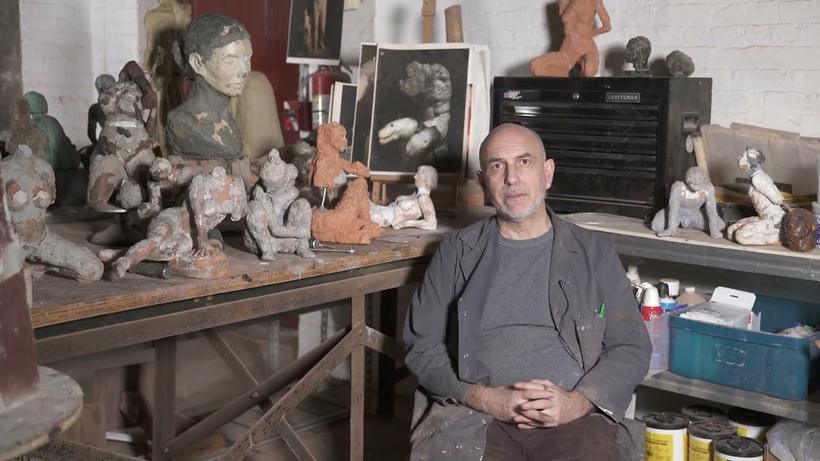
Films retain their original audio. Where YouTube supplies captions, use the CC control. The text on this page introduces the sculpture and its historical setting.
History and inspiration
The Byzantine Empire lasted from 330 to 1453. It continued the Roman state while developing a Christian culture in which images served worship, imperial authority, and everyday devotion.
Constantine’s colossal portrait offered a starting point for Archon: a human head made larger than life, with a gaze that suggests power beyond the individual. Petrides brings that inherited visual language back to the scale of family memory.
Read the full catalog chapter (English)The artist’s words (English)
"Archon is inspired by my father, a sea captain— a figure of leadership, clear vision, decision-making. His childhood was marked by scarcity and threat, and his adult conviction that survival depends on keeping one’s eyes open and prioritizing his family’s safety. These values were passed on to me, with little tolerance for self-indulgence: there were high expectations in every respect.
As to the sculpture: the word 'archon' means 'ruler' or 'leader,' and the sculpture reflects that: a heavy brow and concentrated gaze, occasionally austere. Archon shows another way trauma travels.
Archon, like Thalia, has spawned variations that have found their way to many cities around the world. The largest one is the monumental Constantine Regarding the Cross, in Southampton, NY."
Contact the studio
Arrange a visit in Berlin, discuss an institutional project, or request information about a work.