Chapter 01 / 06 · 510–323 BC
Thalia
Foundation of Western Civilization
Classical Greece
The person behind the portrait
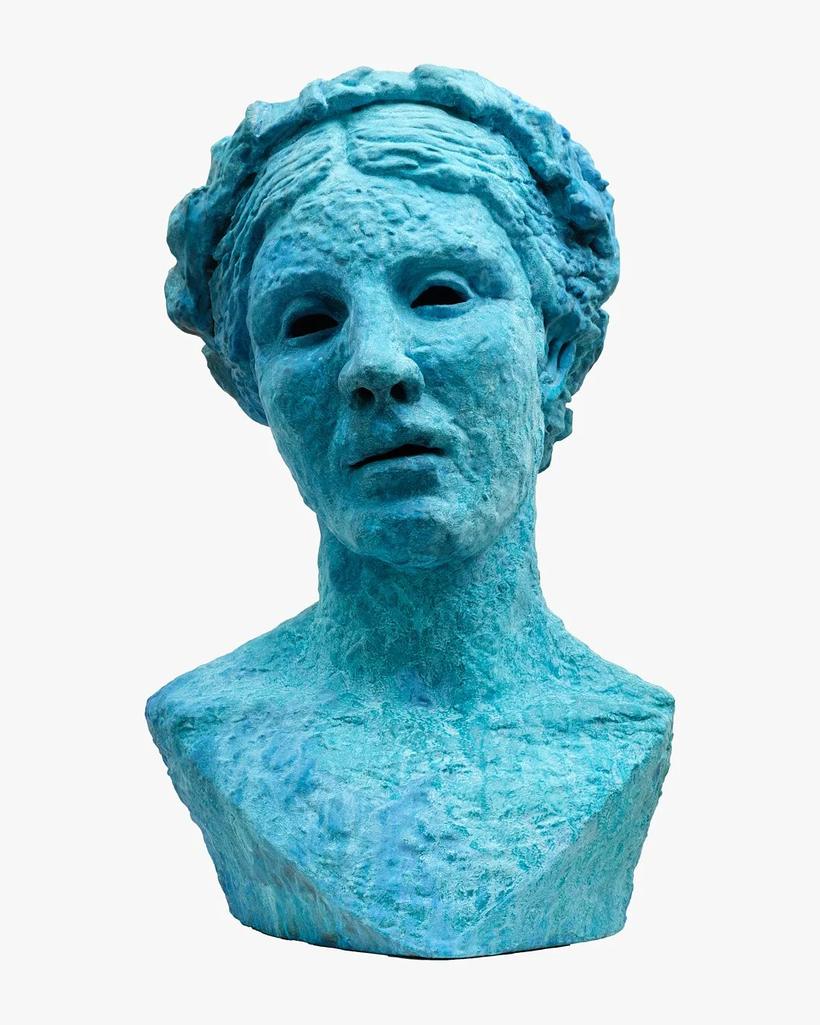
Thalia began with an ancient sculpture and gradually became a portrait of the artist’s mother. Working from a black-and-white photograph taken around 1950, Petrides found that her features and thoughtful expression were replacing those of the classical model.
Panayota grew up through the Nazi occupation and the Greek Civil War. The portrait’s quiet beauty holds that difficult family history without illustrating it directly.
Artwork details and materials
- Reference
- HH·01
- Model
- Panayota Papaioannou
- In the family
- Mother, from photographs taken around age 20
- Themes
- Thoughtfulness and classical beauty
- Sculptural precedent
- Thalia, Muse of Comedy, a Roman copy of a Greek work; Vatican Museums, Rome
- Completed
- 2024 · Version III
- Medium
- Mixed media: a 3D-printed recycled PETG body, epoxy clay, metal powders applied with resin and catalyst, pigments, acids, and a protective topcoat.
- Dimensions
- 86 × 55 cm, height × diameter
The date identifies the version shown. The exhibition began touring in 2022.
Views and surface details
Select an image to see it in full.
The films
Films retain their original audio. Where YouTube supplies captions, use the CC control. The text on this page introduces the sculpture and its historical setting.
History and inspiration
The Classical period transformed Greek sculpture, philosophy, theater, and civic life. Sculptors moved toward natural poses and close observation of the human body, while seeking proportion and balance. Its achievements coexisted with a society in which women and enslaved people had few rights.
Petrides’s starting point was Thalia, the muse of comedy, in the Vatican Museums. The Roman sculpture preserves a Greek tradition, just as this new portrait carries an older form into a different life and time.
Read the full catalog chapter (English)The artist’s words (English)
"As described in the Clay to Code to Bronze essay, the sculpture Thalia is inspired by my mother as a young woman around 1950, based on a black-and-white photograph shown there. She was a teenager in the decade of the 1940s in Greece, when the country was overwhelmed by two wars: the Nazi occupation and the ensuing Greek Civil War, ending in 1949. What that must have been like for her and for my father, who was a year older, is inconceivable. There was scarcity of food and a constant threat of violence. As she grew up, she must have carried both her mother’s refugee past and her own wartime childhood wounds. Again, as a sensitive child, I absorbed lessons in habits, worries, and unspoken rules.
As to the sculpture, I hope that Thalia captures some of the likeness but, more importantly, the emotion of the black-and-white photograph. I see the expression as serious and thoughtful, perhaps guarded.
There are many variations of Thalia around the world, in as many as seven countries. Something about her thoughtful beauty touches people."
Contact the studio
Arrange a visit in Berlin, discuss an institutional project, or request information about a work.