Classical Greece
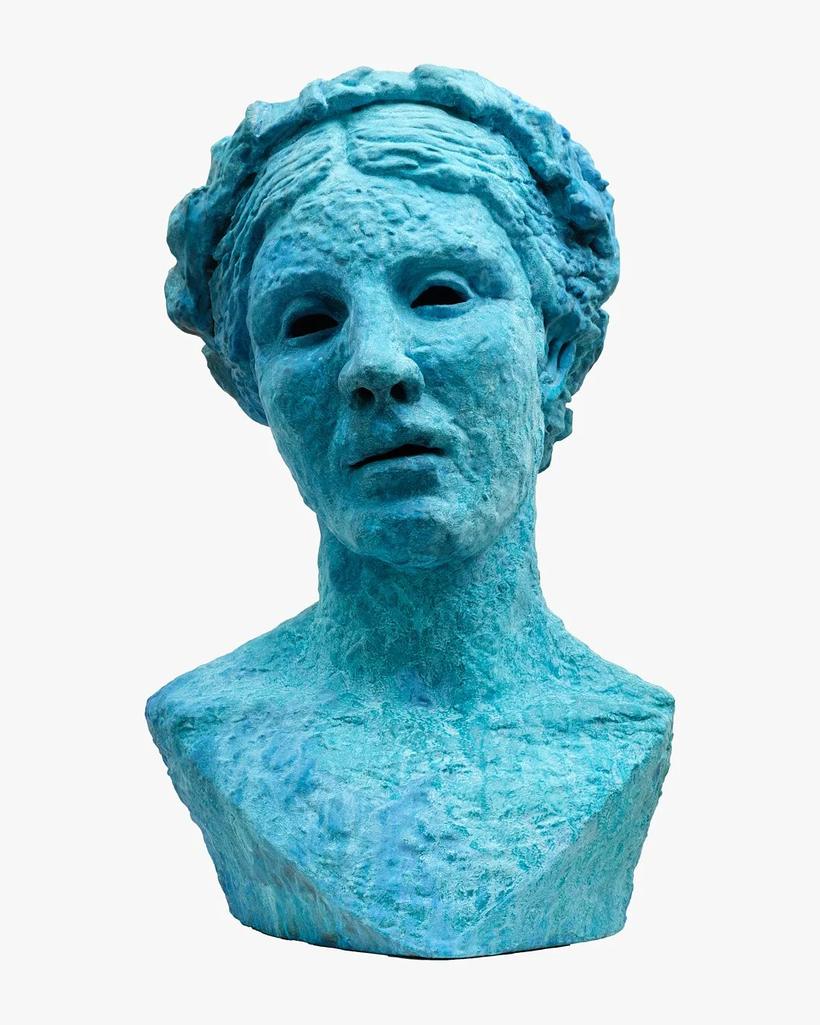
Thalia — Foundation of Western Civilization
 Play documentary
Hover to magnify · click to open
Play documentary
Hover to magnify · click to open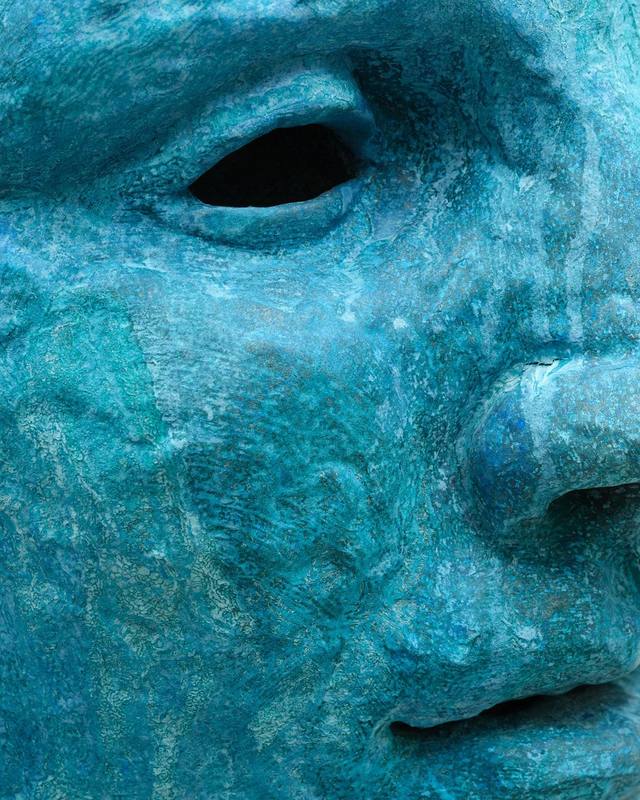 Detail · tap
 View · tap
 View · tap
 View · tap
 View · tap
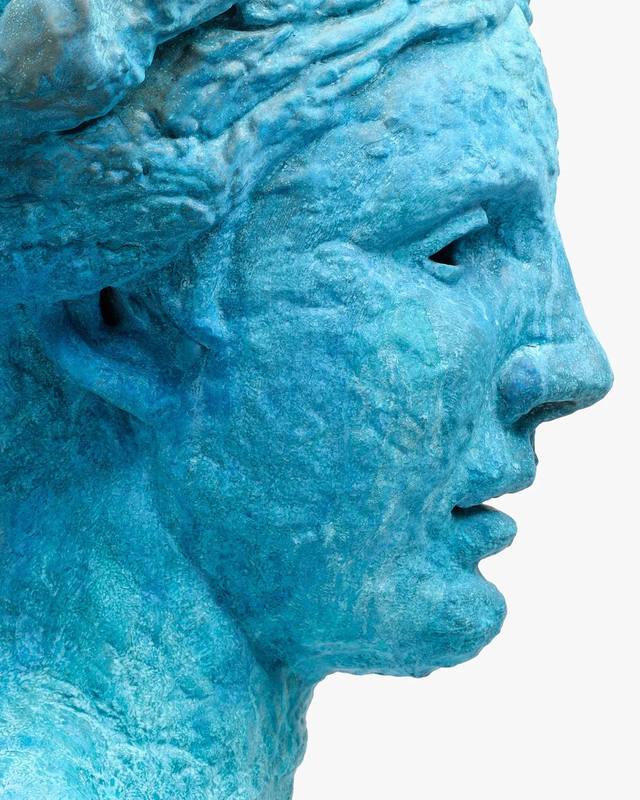
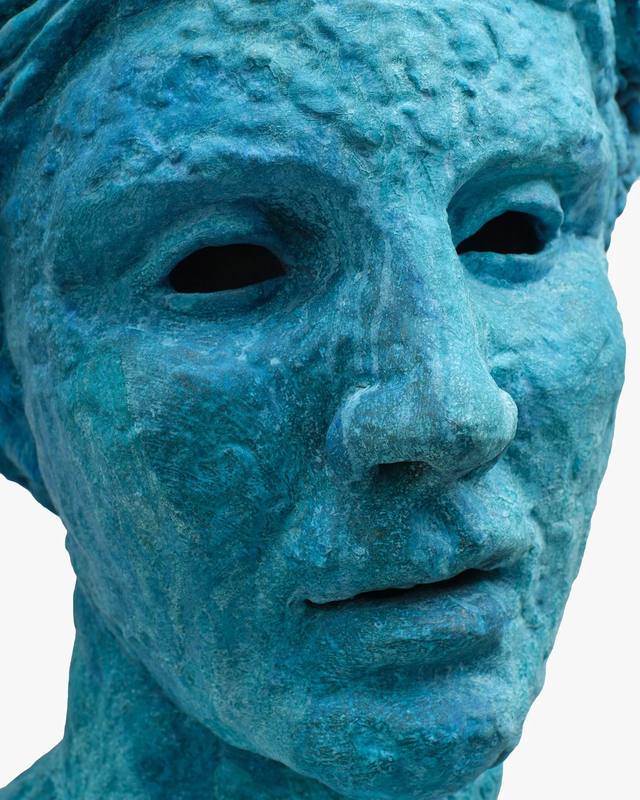
"As described in the Clay to Code to Bronze essay, the sculpture Thalia is inspired by my mother as a young woman around 1950, based on a black-and-white photograph shown there. She was a teenager in the decade of the 1940s in Greece, when the country was overwhelmed by two wars: the Nazi occupation and the ensuing Greek Civil War, ending in 1949. What that must have been like for her and for my father, who was a year older, is inconceivable. There was scarcity of food and a constant threat of violence. As she grew up, she must have carried both her mother’s refugee past and her own wartime childhood wounds. Again, as a sensitive child, I absorbed lessons in habits, worries, and unspoken rules.
As to the sculpture, I hope that Thalia captures some of the likeness but, more importantly, the emotion of the black-and-white photograph. I see the expression as serious and thoughtful, perhaps guarded.
There are many variations of Thalia around the world, in as many as seven countries. Something about her thoughtful beauty touches people."
Classical Greece · 510–323 BC
As the birthplace of many of the pillars of Western civilization, classical Greece may be the period most familiar to history students of all levels. Though major historical events like the Peloponnesian Wars, the Spartan and Theban hegemonies and the expansion of Macedonia were constantly reshaping its borders, the rich culture of Classical Greece was forming and strengthening.
Its legacy in the form of politics, art, science, theater, literature, and philosophy extended far beyond its time period and region to influence the culture of the Roman Empire, and become the very foundations of modern civilization, specifically in the West. This legacy was particularly instrumental in shaping the European Renaissance and the generations that followed it: “The legacy of Greece was strongly felt by post-Renaissance European elite, who saw themselves as the spiritual heirs of Greece. Will Durant wrote in 1939 that “excepting machinery, there is hardly anything secular in our culture that does not come from Greece,” and conversely “there is nothing in Greek civilization that doesn’t illuminate our own.”1
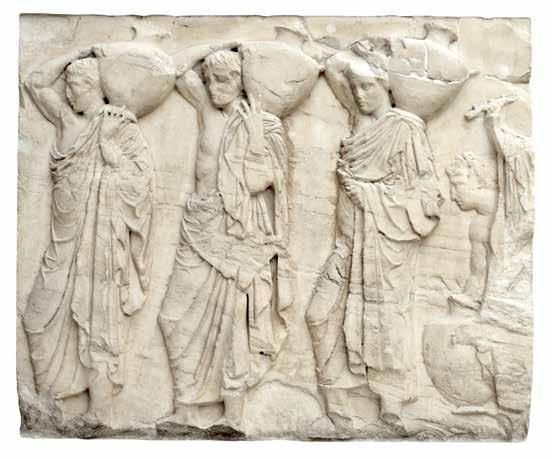
We have some clues as to what life was like for Greek citizens during the Classical era: “In Athens, society was male-dominated–only men could be citizens and only upper-class males enjoyed a formal education. Women had few political rights and were expected to remain in the home and bear children. Fully one quarter of the population was made up of slaves, usual ly prisoners captured during the many clashes that extended Greek influence overseas. These slaves provided much of the manpower that fueled the burgeoning economy, working in shipyards, quarries, mines, and as domestic servants. “Most homes were modest, windowless and wrapped around a courtyard. Furniture was rare. People spent the majority of the day out of doors enjoying the mild Mediterranean climate. The Greek diet was also modest, based largely on wine and bread. A typical day would start with bread dipped in wine, the same for lunch and a dinner of wine, fruits, vegetables and fish. Con sumption of meat was reserved for special occasions such as religious holidays.”2 The women of Classical Greece had few rights compared to those of their male counterparts; for example, they could not vote or inherit land, and were thus largely relegated to the do mestic sphere. And yet, despite the social restraints, there were a number of important female goddesses (Demeter, Artemis, Persephone, etc.) the likes of which were never available to Christian women. In particular, Athena, goddess of wisdom and warfare, is one of the most powerful figures in Greek mythology: “The Parthenon on the Athenian Acropolis is dedicated to her, along with numerous other temples and monuments… She was also a warrior goddess, and was believed to lead soldiers into battle as Athena Promachos. Her main festival in Athens was the Panathenaia, which was the most important festival on the Athenian calendar.”3
Classical Sculpture
In the context of the art, architecture, and culture of Ancient Greece, the Classical period covers most of the 5th and 4th centuries BC (the most common dates being the fall of the last Athenian tyrant in 510 BC to the death of Alexander the Great in 323 BC). The Classical period in this sense follows the Greek Dark Ages and Archaic period and is in turn succeeded by the Hellenistic period. As for sculpture during this time, the Classical Period brought about “a revolution in Greek statuary, usually associated with the introduction of democracy and the end of the aristocratic cul ture...The Classical period saw changes in the style and function of sculpture. Poses became more naturalistic (see the Charioteer of Delphi for an example of the transition to more naturalistic sculpture), and the technical skill of Greek sculptors in depicting the human form in a variety of poses greatly increased. From about 500 BC statues began to depict real people. The statues of Harmodius and Aristogeiton set up in Athens to mark the overthrow of the tyranny were said to be the first public monuments to actual people...
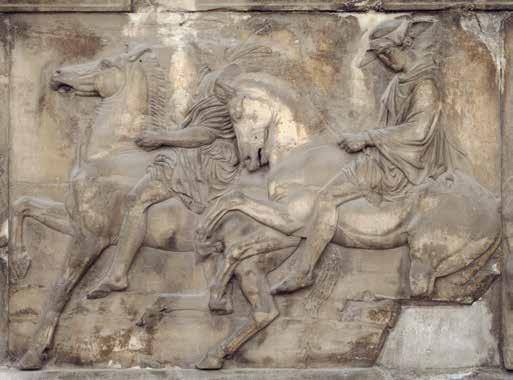
“In the Classical period for the first time we know the names of individual sculptors. Phidias oversaw the design and building of the Parthenon. Praxiteles made the female nude respectable for the first time in the Late Classical period (mid-4th century): his Aphrodite of Knidos, which survives in copies, was said by Pliny to be the greatest statue in the world.”4 Another renowned sculptor of the time was Polykleitos of Argos, who was “particularly famous for formulating a system of proportions that achieved this artistic effect and allowed others to reproduce it. His treatise, the Canon, is now lost, but one of his most important sculptural works, the Diadoumenos, survives in numerous ancient marble copies of the bronze original. Bronze, valued for its tensile strength and lustrous beauty, became the preferred medium for freestanding statuary, although very few bronze originals of the fifth century BC survive. What we know of these famous sculptures comes primarily from ancient literature and later Roman copies in marble.”5
The Muses
A group of goddesses that have had lasting cultural impact are the Muses. The Muses or “nine sisters” were the goddesses of literature, science, and the arts. Usually presented as the daughters of Zeus, they were thought to have allowed people to forget their pain. They played an important role in artistic life, but also in civic life: “When Pythagoras arrived at Croton, his first advice to the Crotoniates was to build a shrine to the Muses at the center of the city, to promote civic harmony and learning.”6 Thalia was one of the two muses of the Greek theater. Her name means “flourishing,” perhaps because her songs were thought to sound new even as they aged.
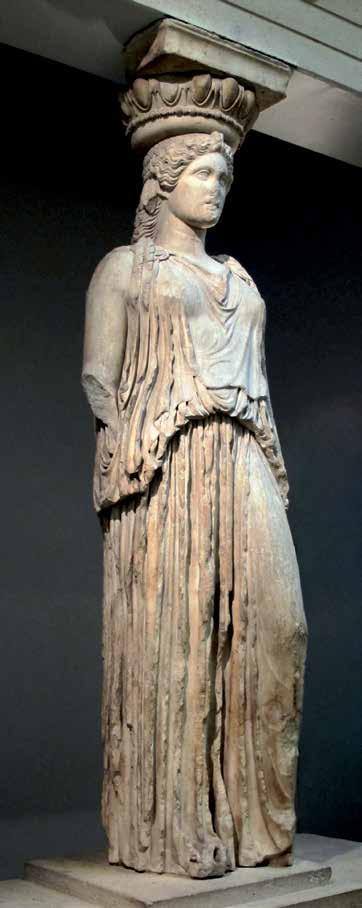
The Muses were often portrayed in all manner of artworks, from literature to sculpture. “Ancient authors and some later authors and artists invoke Muses when writing poetry, hymns or epic history.”7 They were so prevalent in works of art that they have become embedded in the very idea of art and creativity; the word muse has come to represent an artist’s inspiration, and it is the root of the word museum.
Greece (ca. 480–323 B.C.).– In Heilbrunn Timeline of Art History. New York: The Metropolitan Museum of Art, 2000–. http://www.metmuseum.org/toah/hd/tacg/hd_tacg.htm
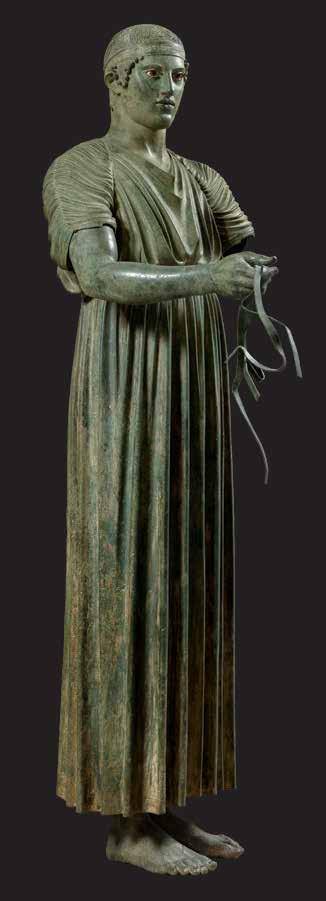
National Archaeological
Archaeological Museum of Delphi, Greece. Source: Aρχαιολογία. Εύβοια και Στερεά Ελλάδα, Melissa Publishing House, Athens 2008. Photo by Ilias Iliadis.
Sculptural
Precedent F
or this first period, the Classical Greek period, I select ed as sculptural precedent a piece that I had fallen in love with in Rome when I saw it at the Vatican Museums. This sculpture, Thalia, Muse of Comedy, was recovered from an excavated Roman villa near Tivoli and probably dates from the nd century. It resembles Greek models of the late fourth to early third century BCE, reminding us of Roman dependence on Greek originals. Many of the Greek originals have been lost and we now appreciate them through Roman period copies, such as this.
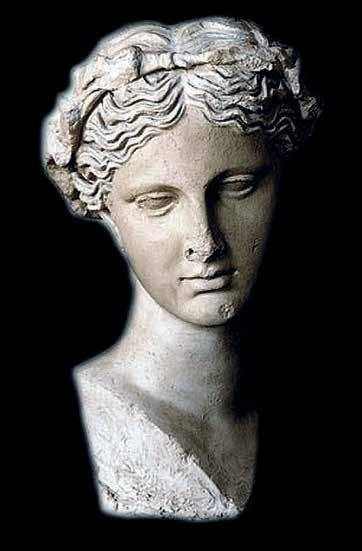
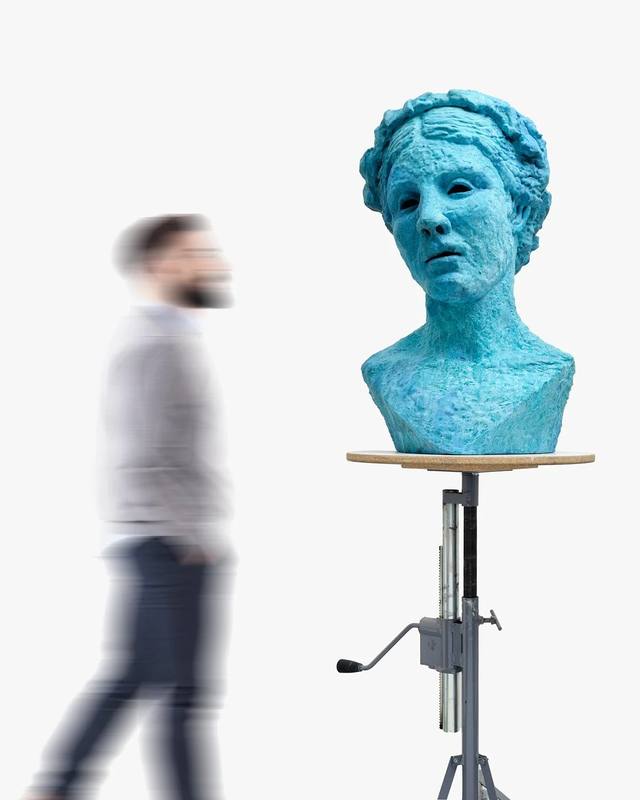
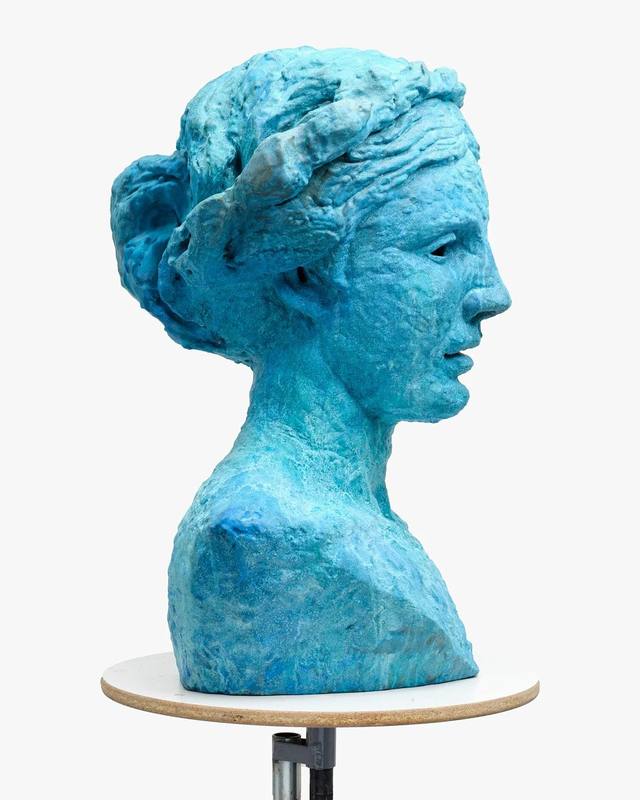
The sculpture depicts Thalia, the eighth born of the nine Muses. The villa where the sculpture was excavated in 1775 was initially thought to have belonged to Cassius, the foremost instigator of the murder of Julius Caesar, though this assess ment has been more recently disputed. Thalia is typically por trayed in art as “a young woman with a joyous air, crowned with ivy, wearing boots and holding a comic mask in her hand. Many of her statues also hold a bugle and a trumpet (both used to support the actors’ voices in ancient comedy), or occasionally a shepherd’s staff or a wreath of ivy.”8 I was inspired by the beauty and mood of this piece, and the details of the crown and hair which stood in contrast to the more simply defined face. As I started to make a version of it in my studio, without my intention or knowledge of it occurring, my sculpture took on the characteristics of my mother, specifically as a woman around twenty years of age from a black and white photograph taken in Athens in a garden, sitting and talking with a cousin. As I kept working on the piece, the only thing that re mained of the Vatican Thalia was the crown and hairstyle; the features had changed to resemble my mother from that time and place.
- 1. Wikipedia contributors. (2023, October 23). Classical Greece. In Wikipedia, The Free Encyclopedia. Retrieved 14:40, November 15, 2023, from https://en.wikipedia.org/w/ index.php?title=Classical_Greece&oldid=1181586495
- 2. “Everyday Life in Ancient Greece, 4th Century BC.” (2001). In EyeWitness to History. Retrieved November 15, 2023, from www.eyewitnesstohistory.com.
- 3. Wikipedia contributors. (2023, November 11). Athena. In Wikipedia, The Free Ency - clopedia. Retrieved 15:34, November 15, 2023, from https://en.wikipedia.org/w/index. php?title=Athena&oldid=1184642707
- 4. Wikipedia contributors. (2022, July 19). Ancient Greek art. In Wikipedia, The Free Encyclopedia. Retrieved 16:04, July 20, 2022, from https://en.wikipedia.org/w/index. php?ti - tle=Ancient_Greek_art&oldid=1099177658
- 5. Hemingway, Colette, and Seán Hemingway. (January 2008) “The Art of Classical
- 6. Wikipedia contributors. (2023, November 9). Muses. In Wikipedia, The Free Encyclopedia. Retrieved 15:53, November 15, 2023, from https://en.wikipedia.org/w/index.php?ti - tle=Muses&oldid=1184310119
- 7. Wikipedia contributors. (2023, November 9). Muses. In Wikipedia, The Free Encyclopedia. Retrieved 15:53, November 15, 2023, from https://en.wikipedia.org/w/index.php?ti - tle=Muses&oldid=1184310119
- 8. Wikipedia contributors. (2022, June 7). Thalia (Muse). In Wikipedia, The Free Ency - clopedia. Retrieved 17:32, July 24, 2022, from https://en.wikipedia.org/w/index.php?title=Thalia_(Muse)&oldid=1092041177